|
Preemptive Bidding - Take that, opponent!
Early in our Bridge career
we learned the value of honor cards, 10 High Card Points (HCP)
per suit, 40 HCP in the deck. So on balance each player
holds 10 points. Opening the bidding assumes a hand better
than average, typically 12-13 points. We've also learned how
long suits can develop extra tricks by promoting the suit.
Imagine holding an eight card suit headed with the
Ace-King-Queen-Jack; except with the worst trump split
(8-5-0-0), we are assured to make 5 tricks even though we
only hold 10 HCP. Thus, we've learned to reassess hands
containing suits longer than four cards on length. This
realization is doubly beneficial, allowing us to:
1. Open marginal hand with
less than normal values
2. Invoke a preemptive "first strike" bid when holding a
substandard hand with extra length and strength in one suit
Depending on partnership
agreements, preemptive bids come in various sizes and
shapes. Certainly 3 level opening preempts have been around
for some time. When Charles Goren initially wrote "Goren's
Bridge Complete," 2 level bids promised 23 or more points.
But times have changed - in Goren's 1985 book rewrite, his
"new" method advocated weak two bids, preemptively opening 2
Diamonds, 2 Hearts, or 2 Spades. Similar to the 3 level
preemptive opening bid with a seven card suit, the weak two
opening bid (or overcall) shows a six card suit with 6-12
points including distribution (except 2 Clubs, which becomes
the catch-all strong opening bid).
In addition to weak two and
weak three bids, other preempts include weak jump overcalls,
weak double- jump game raises, and perhaps weak jump shifts.
How about you and your partner? Are your preempts "heavenly"
or do you find jump bids more like a boomerang, missing the
intended target and heading back to whack you? In our
series, we will take a look at preempt strategies,
environmental factors, hand evaluation consideration,
risk-reward factors, and what to do after you or partner has
"cast a preemptive spell."
Let's begin this lesson by
asking the obvious question: why should we make preemptive
bids? A preemptive bid has several benefits:
1. Communicate to partner
both the length and strength attributes in preemptive suit,
where we would otherwise had to pass the bidding.
2. Consume bidding space to inhibit accurate bidding by
opponents - if we have a long suit, it stands to reason
others will also have offsetting length and strength in a
suit of their own.
3. Provide lead direction to our partner should opponents
ultimately win the contract.
4. Potentially provide partner the opportunity to raise the
preempt suit when opponents enter the auction bidding
another suit.
Before delving into the
dark side of preemptive bids, we should set the record
straight - like other aspects of Bridge bidding and play,
preemptive bids are not guaranteed to get the best results
in all situations. Bridge is a game full of variables. Our
results are influenced by factors including the placement of
the cards (honors and suit distribution), the partnership
and opponent vulnerability, the attitude of the players on a
given hand, the interpretation bidding around the table,
perceived bidding and play ability, and numerous other
considerations.
We should also stress that
our failure to make a contract is not always a dishonorable
event. Bridge scoring only allows one side to enter a
positive or negative score (excepting honor bonuses in
Contract Rubber Bridge). So if your partner makes a
preemptive bid that ultimately goes down one trick, that
result is certainly better than if partner passed and the
opponents made game or slam. Yet perhaps you have had some
unpleasant experiences getting set in a contract and are a
bit hesitant making a preemptive call. Fair enough, in this
lesson we will examine the "good, bad, and the ugly" in
assessing the time is ripe to make a preemptive bid. But
right off the bat, we profess there are at least two
situations where making a preemptive bid is unwise:
1. When you're playing with
(or against) your future in-laws!
2. When you're playing a high-stakes money game and can't
cover possible losses!
In our discussion, we will
focus on sound preemptive bidding theory that balances the
risk/reward relationship of preemptive bidding, i.e., bids
that should work well most of the time. Additionally, our
partner is entitled to have a reasonable assurance of our
length and strength holding when we make a preemptive bid -
after all, Bridge is a partnership game so our preempts
should be disciplined. Otherwise, our poor partner will be
clueless when to pass or bid onward to game and beyond. And
just because we have made a preemptive call, it's not
unreasonable to envision our partner holding a strong hand
with interest in making either a game or slam contract.
Further, when the opponents make an overcall after our
preemptive bid, our partner may wish to make a penalty
double. So our preemptive bidding should provide partner a
good assessment of our holding.
So what constitutes a good
preempt hand and when should we make a preemptive bid? As we
would expect, a preemptive hand is one that generally has
less than the 12-13 points required to make a normal opening
bid. Disciplined preempts promise we have both strength and
length limited to the preempt suit. Most players consider
two of the top three honors (A-K-Q) a prerequisite for a
preemptive bid or at least hold 5 HCPs in the suit (K-Q or
A-J-10). However some players stretch a bit, opening
preemptively holding only the Q-J-10-9 in the preempt suit;
later, we will discuss other factors to consider when making
a preemptive bid. Why do we emphasize the trump quality of
the top three trump honors? A fair question - because we do
not expect to lose the fourth trick or beyond when we hold a
long suit; it's the first three tricks that deserve
attention. Here are some hands to illustrate the point
(assuming partner has not made a bid):
A great suit, six tricks
seems certain:
A K Q x x x
We anticipate 5-6 tricks:
A K J x x x
A Q J x x x
We hope for 5 tricks on a
good day:
A K x x x x
A Q 10 x x x
A J 10 x x x
K Q 10 x x x
We realize the hand will
only take 4-5 tricks without help from partner:
A Q x x x x
A J 9 x x x
K Q x x x x
K J 10 x x x
Finally, here are some marginal 4 trick suits reserved for
the bold and desperate:
A 10 9 x x x
K J x x x x
K 10 9 x x x
Q J 10 x x x
Q J 9 x x x
When we make a preemptive
call, we advise partner that we envision taking most of the
tricks in the preempt suit. Further, our preemptive call
implies our hand does not contain more than one trick in our
side suits. If we hold two or more defensive tricks and a
long trump suit, we should either make a normal opening bid
or pass knowing we have enough tricks to keep the opponents
out of game. Thus, our disciplined preemptive hand is
essentially valuable to make offensive tricks in the preempt
suit, with little trick-taking opportunity in the side
suits. Of course, in some situations preemptive bids may be
made with an opening hand. Let's say our partner has passed
the bidding and we can judge from our values that game is
very unlikely. Or perhaps we see a benefit making a jump
overcall after one or both opponents have bid. Some advanced
players even go so far as to play responder's jump-shift bid
in a new suit as weak (typically after an opponent has made
an overcall). But at our level, let's avoid those sexy
advanced bids and master the basics of preemptive bidding.
Before we continue, let's
review how to evaluate our effective points in the preempt
suit. Perhaps you have already been exposed to the concept
of "length points" in addition to traditional HCP. When we
hold a 5 card suit, we add an extra length point since the
hand should enjoy extra tricks once the preempt suit has
been promoted. Holding a seven card suit, we add 3 length
points to our effective point count: seven cards minus a 4
card baseline equals 3 extra distribution points. If we play
2 level preempts, we add two points (6 - 4 = +2 points), and
so on.
Holding a seven card suit,
we typically preempt at the 3 level. Playing the modern
Bridge bidding style, we may also preempt at the 2 level
holding a six card suit (2 Diamonds, 2 Hearts, or 2 Spades),
also known as 2 level preemptive bids. Since 2 Clubs is
reserved as our all purpose strong bid with 22 points or
more, holding a weak six card Club suit we must pass or
aggressively make a preempt call of 3 Clubs. Okay, off to
the table to discuss some hands:
A K
x x x x x
x
x x x
x x
An ideal hand to open 3
Spades with a nice 7 card suit.
x
J x
x x x
K J 10 9 x x x
3 Clubs is fine with our
fair suit and no defensive tricks.
Open 1 Heart with 11 HCP
plus 3 length points. Game is still within sight.
A K Q x x x
x x
x x x
x x
Playing preemptive weak two
bids, we would proudly open 2 Spades. But what if partner
only plays weak three bids as preempts? With such solid
values, we recommend opening 3 Spades as though the suit
held seven cards - without much help the suit will take six
tricks. And on a bad day when your side goes down, you can
feign ignorance, claiming you could have sworn you saw 7
Spades. Perhaps a Club was mixed in with all those Spades -
after all, the lighting is a bit dark where you are seated!
So if 3 level bids show weak
hands and most 2 level bids are also preemptive, what does
it mean when a player opens the bidding at the 4 or 5 level?
If you said an eight card suit or longer, great - you have a
good grasp of opening preempts. Still, let's explore some of
the subtleties of these bids. As our regular BridgeHands
readers will attest, whenever we look at our hand we should
consider the "Rule
of Anticipation." This rule advocates we consider other
players will likely hold the compliment of our hand
(strength and suit shape). So when we hold an eight or nine
card suit, it's likely other players will either hold a suit
of similar length or the opponent's combined suit length
will be very long. The implication here is that holding
either an eight or nine card minor suit, we should strive to
open the suit 5 Clubs or 5 Diamonds. The opponents are
likely to be bidding a major suit game with length and
strength; so a 4 level weak bid in a minor suit is much less
effective compared to a preemptive 5 level opening call. Of
course, from time to time the opponents may make a penalty
double so, as always, we should consider possible defensive
tricks, vulnerability and other environmental factors. More
on this later.
Okay, are you ready for a
trick question? What should you open when you're lucky
enough to hold a nine card major suit? Actually, 4 Hearts or
4 Spades is already a game bid. Since its unlikely most sane
opponents will make an overcall, bid your major suit game at
the 4 level. Some advanced players have fancy methods for
rare calls at the 5 level, but they seldom come up. And
since it's unlikely we will remember the agreements at that
time, let's forgo discussing such obtuse bids.
Next let's talk about your
shape. Of course we are talking about the card length in
each suit! As you might guess, we have the "good, bad, and
the ugly" hand shapes in Bridge. In essence, a "flatter"
hand is less likely to take tricks. So a more balanced hand
shape like a 6-3-2-2 hand will take far less tricks than a
6-5-2-0 shape. Bottom line - do not preempt two-suited hands
that have a strong potential to make a major suit game
(i.e., don't preempt the rare hand). Statistically speaking,
here are the possible holdings of various hand patterns
associated with preemptive bids.
Six card suit:
6-3-2-2 5.6 percent
6-4-2-1 4.7 percent
6-3-3-1 3.5 percent
6-4-3-0 1.3 percent
6-5-1-1 0.71 percent
6-5-2-0 0.65 percent
6-6-1-0 slim!
Seven card suit:
7-3-2-1 1.9 percent
7-2-2-2 0.51 percent
7-4-1-1 0.39 percent
7-4-2-0 0.36 percent
7-3-3-0 0.27 percent
7-5-1-0 0.10 percent
7-6-0-0 almost nil!
Did you notice the combined
percentage of possible preemptive six card suits? The total
of 6-3 and 6-4 hands is 5.6 + 4.7 + 3.5 + 1.3 = 15.1 percent
of total Bridge hands (remember, we avoid preempting two-
suited 6-5 hands). No wonder 2 level preempts with a six
card suit are so popular! Assuming you will not have opening
points about half the time yet hold decent honors in your
long suit, you can enjoy entering the auction with a
preemptive bid. And as we know, all red-blooded Bridge
players simply love to bid something.
Now let's cover some
additional guidelines associated with preemptive bids. While
we'd like to call them rules, the fact of the matter is that
there are not many universal agreements by Bridge players -
yes, we are such a fickle group. Here's some friendly advice
when preempting in the first and second seat:
As previously discussed:
1. Strive to hold at least
5+ HCP in your preempt suit (or at least Q-J-10).
2. Do not open preemptively
with a two-suited hand. In fact, there's even a poignant
saying, "With 6-5, come alive" (meaning strive to bid game).
3. Do not open preemptively
with more than one useful outside honor (likely defensive
tricks).
Here are some additional
recommendations:
4. Never mix preempts with
your opponents - if they make a preemptive bid, you should
pass with preemptive values. If you directly make an
overcall, your partner is entitled to assume you have an
opening hand and will probably bid on to game or slam.
Holding a substandard hand after an opponent preempts, relax
and let your partner decide the best action.
5. Two-level preempts are
acceptable with an Ace in an outside side suit, provided the
hand evaluates to less than 12 points (including 2
distribution points for a six card suit).
6. Three-level preempts
should not hold an outside Ace. That hand would include 4
points for an Ace, 3 length points for a seven card suit,
plus our trump honors - rather than preempting, we should
make a normal opening bid.
7. Side suit voids are okay
(some would disagree), although we profess such a hand is
indeed shapely.
8. Preempting with a weak
two bid and a four card side suit is questionable,
especially if the side suit is Hearts or Spades. Most good
players certainly would not open with a weak two bid if the
side suit major contained a useful honor.
9. Never preempt when you're
having a bad day or your partner will subsequently punish
you. Of course we are jesting! Yet all frequent Bridge
players certainly will have some stories to share regarding
the emotional side of our game!
Okay, now let's consider
some of the environmental factors - when the stars are in
the right position to make our preemptive call. Here are
some primary considerations:
1. Vulnerability
2. Relative seat position (how many players have previously
passed)
3. Prior bids by others (opponent/s, partner)
4. Table presence
5. Fourth seat bidding
1. Vulnerability - When our
side is vulnerable, the good news is that we obtain a
premium score for making game or slam; ditto for the
opponents making game or slam. Of course, the downside is
that when we fail to make our contract the penalty for
undertricks is higher (also see Duplicate scoring) -
significantly higher when the opponents double our final
contract. Generally speaking, we have three scenarios from a
preemptive bidding perspective:
a. Favorable vulnerability -
opponents vulnerable, we are non-vulnerable
b. Neutral vulnerability - both sides vulnerable or both
sides non-vulnerable
c. Unfavorable vulnerability - we are vulnerable, opponents
are non-vulnerable
From a risk-reward basis, we
feel a greater sense of impunity with favorable
vulnerability. A good analogy is the green light - go ahead
with reasonable preempts. With neutral vulnerability (yellow
light), we proceed with caution. Thus, with
adverse/unfavorable vulnerability, we'd better look both
ways (figuratively speaking) before making a preemptive bid
- here's a good time to double-check the quality of your
preempt suit.
Here's a twist on preemptive
bidding used by some players. We try to avoid burdening you
with lots of arithmetic formulas, but it's probably worth at
least acquainting our frisky bidders with the Rule of 2-3-4.
Here's how it works - we open preemptively at a varying
level (2 level, 3 level or 4 level) based on the
vulnerability. Indeed, that's certainly different than what
we've been advocating elsewhere. By the way, some limit this
approach to the Rule of 2-3, believing you should always
restrict your losses to 500 points. But for the sake of
completeness, let's review the complete 2-3-4 method to
witness how it works.
With favorable
vulnerability, open preemptively to the level you'll lose 4
tricks.
With neutral vulnerability, open preemptively to the level
you'll lose 3 tricks.
With adverse vulnerability, open preemptively to the level
you'll lose 2 tricks.
The notion here is that when
you have a weak hand, on average partner will have at least
two playing tricks. This is a reasonable proposition,
provided you can properly evaluate the likely losers you
hold when making a preemptive bid. Here's a few hands:
Favorable vulnerability = 4
losers:
Q J 10 9 x x x
x x x
x x
x
Assume 5 Spade tricks 5
tricks plus 4 losers equals 9 tricks, so we bid 3 Spades
Neutral vulnerability = 3
losers:
x x x
x
Q J 10 9 x x x
K Q
Assume 5 Diamonds and 1 Club
5+1 tricks plus 3 losers equals 9 tricks, so we bid 3
Diamonds
Unfavorable vulnerability =
2 losers:
x x
x
Q J 10 9 x x x
K Q x
Assume 5 Diamonds and 2
Clubs
Wait a minute!
With two defensive Club
tricks, we should pass.
Unfavorable vulnerability =
2 losers:
x x x
x
Q J 10 9 x x x
K Q
Assume 5 Diamonds and 1 Club
(reprint of prior hand) 5+1 tricks plus 2 losers equals 8
tricks, so we cautiously bid 2 Diamonds
Let's stress one important
point before we proceed. When we make a preemptive call, we
must not bid again unless instructed to do so through
partner's forcing bid (see upcoming newsletter). Once we've
cast our preemptive spell, we turn over captaincy to our
partner to pass, bid onward or perhaps penalize the
opponents. In Bridge as in life the saying goes, "Speak now
or forever hold your peace."
2. Relative seat position -
here again, we have three basic scenarios:
a. Preempting in third seat
(two passes so far)
b. Preempting in first seat
(no one has bid)
c. Preempting in second seat (only Right Hand Opponent has
passed)
Did we trip you up ordering
preempts in this sequence? For a moment, let's look at
preempts from our partner's perspective. When are we least
likely to make a preemptive bid that will influence partner
holding a good hand? That's right, it's the third seat - our
partner has already passed so the only person we can affect
with our preemptive bid is the unfortunate opponent in the
fourth seat. Sitting in the first seat as dealer, three
players have the opportunity to bid: two opponents and one
partner. So the odds are one in three (33 percent) that our
preemptive bid will stress our partner. Now do you see why
we show second seat preempt at the bottom? With two
remaining bidders, the odds are one in two (50 percent) that
we will preempt our partner's ability to accurately bid. So
does this mean that we should not preempt in second seat?
No, not at all. But when considering all the various factors
of making a preemptive bid, be sure to at least give some
weighting to the relative seat when bidding. Naturally we
are much more comfortable preempting with great trump honors
in third seat with favorable vulnerability as opposed to a
poor trump suit in second seat with unfavorable
vulnerability.
Here's an interesting hand
to illustrate our point:
x
K x
K x x
Q 10 9 8 x x x
We would pass in 1st and 2nd
seat with two useful honors in side suits, but consider
opening 3 Clubs in third seat. However, please watch your
vulnerability - your mileage may vary!
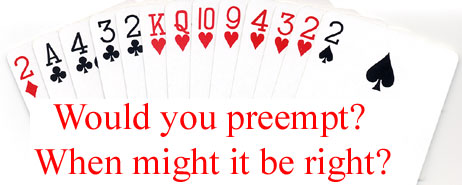
Now let's tackle the
featured hand pictured at the beginning of this newsletter -
what's your bid?
2
K Q 10 9 4 3
2
A 4 3 2
Hopefully you said, "it
depends on the relative seat!" In first or second seat we'd
be inclined to open 1 Heart with 9 HCP plus 3 distribution
points for an acceptable suit with working honors. But what
if you held this hand in the third seat? That's a more
difficult decision. If partner holds 2 Hearts and an Ace and
King, a 4 Heart game should be in the bag. On the other
hand, it's conceivable the opponents might make a 4 Spade
game if we do not make an obstructive call. So we will be
happy to support your third seat decision to open 1 Heart or
3 Hearts. And for our patient black-white thinkers that have
hung in here, we have a treat for you! Since we were not
sure of this hand ourselves, we entered the hand into
Dealmaster Pro, a
Bridge simulator that additionally performs double-dummy
analysis. For the criteria, we assigned North and East
holding less than 12 points and our above hand to South. We
then instructed Dealmaster Pro to randomly deal 1,000 hands
- all three hands could hold any values except our given
cards, and North-South will be assigned passing hand
strength. And the results are:
Heart tricks by South: 12 =
1%, 11+ = 10%, 10+ = 35%, 9+ = 68%
Spade tricks by E/W: 12 = 5%, 11+ = 17%, 10+ = 36%, 9+
= 57%
So what does this mean?
First off, regardless of partner's hand, making 3 Hearts is
fairly safe, likely to make two-thirds of the time (68
percent). Game is possible about one-third of the time (35
percent). At game levels and above (10 tricks), the odds are
slightly better for East-West to make a Spade contract than
our Heart game. Yet at the 3 level, our 3 Heart contract is
11 percent more likely to win 9 tricks than East-West
playing in 3 Spades. In summary, if you are trying to "buy
the auction" then opening 3 Hearts is probably your bid of
choice. On the downside, making the tactical preemptive bid
inhibits our opportunity to enjoy a game contract. So in
balance, here's a situation where we should consider the
likelihood of opponents to enter the auction based on our
various bids. Don't say we didn't warn you in our
introduction - preemptive bidding is sometimes more of an
art than a science!
There are numerous scenarios
where opponent bidding influences our action - more than we
can discuss here but let's consider one provocative
situation. Let's say you are sitting in the third seat with
a very poor hand and the bidding has gone: Pass - Pass - ?
What do you know? Assuming your partner and RHO are not
sleepy, neither player has 12+ points. What would you bid
holding this hand?
Q J 10 x x
x
x x x
Q J x x
Of course, we would never
admit our dirty little secret that in third seat we love
opening 2 Spades with such a trashy hand. But certainly we
know our LHO holds a very big hand with 15+ points, correct?
So depending on your sense for adventure making frisky bids,
let your conscience be your guide (and partnership trust).
3. Prior bids by others - in
prior newsletters, we have discussed finesses. Suit
promotion, ruffing (usually in dummy) and finessing serve as
our three fundamental techniques to develop extra tricks.
Let's say an opponent opens in a major suit showing 5+ cards
in the suit with 12+ points, and you hold a King and two
small cards in the suit.
A Q 10 x x x
K x x
x x x
x
Are you more likely to win a
trick in the suit when your RHO or LHO bid Hearts? Correct,
when your Right Hand Opponent opened 1 Heart. Holding most
of the cards in the suit and likely holding the Ace, we hope
to play a low card from the dummy through RHO and win a
trick with our King. So when one or both of our opponents
have been bidding, we should double-check our honors and
re-evaluate the opportunity to score extra tricks by
finessing. Are you ready to think outside the box? Okay,
let's hold the same cards but swap a few suits:
x x x
x
A Q 10 x x x
K x x
As far as the Heart suit
goes, our partner is more likely to take tricks when our LHO
bid the suit - that will be partner's RHO. Unfortunately,
our King may now be poorly placed and lose the finesse. The
point here is that we should vigilantly reevaluate our hand
as the bidding progresses. And you can always impress your
Bridge buddies throwing around terms like elastic hand
evaluation.
4. Table presence - For a
variety of reasons, some folks live life more boldly than
others and they usually bring such attributes to the Bridge
table (assuming Bridge isn't their alter ego). This
influences their willingness to bid and make overcalls, as
well as their decision to double a preemptive bid by you or
your partner. Or perhaps they would like to penalize you but
are afraid their partner will interpret their double as a
"takeout" bid, forcing their partner to make ill-advised
call. For better or worse, intimidation is another factor -
if we judge our opponent to be a better player, we are
probably not as likely to make a penalty double. Then again,
after spectacular results on a prior hand, both sides may
feel some form of mysterious energy compels them to make an
out of the ordinary bid. Welcome to our fascinating game of
Bridge.
5. Fourth seat bidding -
After three passes, preemptive bidding is a moot point (we
can simply pass), so a 2 level preemptive bid should serve
another purpose. And what might that be, you ask? Well,
here's another specialized bid used by advanced players but
we will throw it in should you and your partner wish to play
it. Of course, never make a conventional bid unless your
partner clearly understands the meaning of the call. For
these players, opening 2 Hearts or 2 Spades in the fourth
seat actually shows an opening hand with a very nice suit
(usually 6 card suit with one loser), and two defensive
tricks. Here's are some examples:
A K J x x x x
Q x x
A x x
Classic 4th seat 2 Spade
opener for those who play it.
A Q J x x x
x
K Q x
x x x
2 Spades here. Incidentally,
in third seat we would open 1 Spade - even though partner is
a passed hand, three honors in the minors could score a game
contract.
A K J 10 x x
x x
Q x x
x x
Open 1 Spade with only one
defensive trick. Rebid 2 Spades next time around.
x
A K J 10 x x
x x x
x x x
Pass (same as above w/o
Diamond Queen). In any other seat we would preempt but that
doesn't work here. Don't open Pandora's box bidding 1 Heart
- the opponents will certainly outbid you in Spades.
Finally, for the curious
players, opening at the 3 level in the fourth seat is a
"shutout" bid with unspecified values. Obviously, this is a
gambling bid anticipating the opener will make the contract,
bidding so high the opponents will not find their contract.
But do they feel lucky, ask you? See item 4 above!
Stay tuned - in upcoming
newsletters we will dig into responder forcing and
non-forcing bids after opener's preempts, opener rebids,
overcalls, and more. |